Showing posts with label whale sharks. Show all posts

Tuesday, 13 May 2008

famous 'stumpy' and first manta rays

we swam with a well known whale shark called 'stumpy' today - i did, not the customers - as 'stumpy' was too close to the reef and it was too dangerous to put the groups in the water. 'stumpy is by far the most famous whale shark at ningaloo reef. click here for an article on 'stumpy'. for more information about this shark click here: A-001


the other good news is that the first oceanic manta rays have arrived at ningaloo reef. every year the stay here in large numbers between may and august. it's always more than just a bonus on the whale shark tours to snorkel with manta rays while the spotter planes look for whale sharks. they are gorgeous creatures.

Tuesday, 6 May 2008

a fin lovin' whale shark

today we swam with two whale sharks of which one was very curious.


it was a 2.5m male shark constantly chasing the snorkellers - they didn't know where to go a were afraid of getting their fins bitten off. this shark was good fun.

Thursday, 1 May 2008

nice big shark

the first big shark this year - almost 8 meters long. this whale shark has been encountered every year at ningaloo since 2002 which is great news. for more information about this shark click here: A-130

Thursday, 24 April 2008

first whale shark this year

first time out this year and we had a great shark in clear blue water. it's a 4m male whale shark that has not been identified before. for more information about this shark click here: A-450

Sunday, 20 April 2008

another whale shark season

in 2008 i'm back on the gold boat 'darling isabelle'. the crew is completely new this year but fran helps out on the boat so will spend a lot of time on the water together which is great!

Saturday, 16 June 2007

whale shark attack!!

today was one of the most exciting whale shark days i ever had. within 25 minutes we found and swam with four different whale sharks in one small area just off ningaloo reef.

but not just that. i filmed something probably no one else in the world has ever encountered before: a whale shark attacking another whale shark! we snorkelled on top of a four meter shark cruising along in about 5-6m of water when all of a sudden a huge (8-10m) whale shark came out of the blue from underneath the smaller shark and clearly attacked and chased it. unbelievable! the water was quite murky but you can still see the attack in my footage:

Friday, 25 May 2007

gentle giants in decline

it's big news on australian tv and radio today: new research shows that the numbers of whale sharks are dwindling:

the iconic whale sharks that congregate at ningaloo reef off western australia are declining in number, according to a recent study published in the journal of animal ecology. researchers from the australian institute of marine science and charles darwin university have used 12 years of whale shark photographs from ningaloo reef to monitor and predict trends in population size. the scientists’ models show a steady decline in numbers of the giant fish. the study follows increased efforts over the last decade to learn more about the ningaloo whale shark aggregation due to fears that over-harvesting outside of australian jurisdiction could pose a threat to the gentle giants. ‘australia’s whale shark population is shared with many other countries in southeast asia and around the indian ocean,’ says fish biologist dr mark meekan. ‘although many countries including india and taiwan have recently halted or reduced their commercial take of whale sharks, continued harvesting throughout southeast asia is probably still occurring.’

(click here for the full story)

whale shark products are sold in many southeast asian countries. it is reputed to be the world's most expensive shark meat. there are various products used from whale sharks including:
- cartilage, blood, gall bladder, corneas and liver are used in a variety of medical treatments
- the meat is eaten and sold as flake or shark meat in fish shops
- the fins are considered a delicacy in asian cooking (shark fin soup)
- the skin can be turned into leather
- the liver oil is used in cosmetics

a large whale shark slaughtered in china

Thursday, 24 May 2007

whale shark A-320

a cute little female with parts of her fins bitten off. for more information about this shark click here: A-320

Thursday, 17 May 2007

four sharks in one day

what a great day! we swam with four different whale sharks! one of them was roger, the 10m leviathan we saw three and five days ago. for more information about this shark click here: A-047

Tuesday, 15 May 2007

whale shark A-399

a whale shark that has never been encountered before. for more information about this shark click here: A-399

Monday, 14 May 2007

whale shark roger

today we swam with the same 10m male shark we found two days ago. as he'd been encountered more than 20 times now we decided he deserves a name. we nicknamed him roger, after our crew member roger who was badly injured two days ago in a car accident on the way to the tantabiddi boat ramp. for more information about this shark click here: A-047

Saturday, 12 May 2007

more sharks for us aquarium

today i found more sad news about the way we treat whale sharks:

two more whale sharks appear to be on their way to the georgia aquarium. fisheries officials in taiwan are ready to approve the export of the male whale sharks to the atlanta aquarium, said a whale shark expert on the east asia island who has reviewed the aquarium's applications. one of taiwan's largest newspapers reported this week that officials have signed off on the transfer."they will probably be exported to the united states in june," said z. shouzheng, an associate professor at national taiwan ocean university. the whale sharks' arrival would raise to five the number of the creatures, known as the world's largest fish, circling in the aquarium's ocean voyager exhibit. the decision to ship the sharks represents an apparent change in opinions about the aquarium's care of them. a male whale shark died at the aquarium in january, prompting questions about a chemical used in their tank to treat parasites, which could have curbed their appetite and led to force-feeding of the fish. the 22-foot whale shark, named ralph, died from peritonitis, an inflammation of the stomach lining. he also had perforations in his stomach, possibly caused by the pvc pipe used to force-feed the leviathan. the aquarium has declined to release the necropsy report detailing the cause of ralph's death. ralph came to georgia in june 2005, along with norton, another male. both were in ocean voyager when the aquarium treated the sprawling tank with a chemical to prevent leeches. the two fish soon stopped eating, prompting the force-feedings. norton is still undergoing the feedings, the aquarium said.
(source: atlanta journal www.ajc.com)

whale shark ralph before he died

Wednesday, 2 May 2007

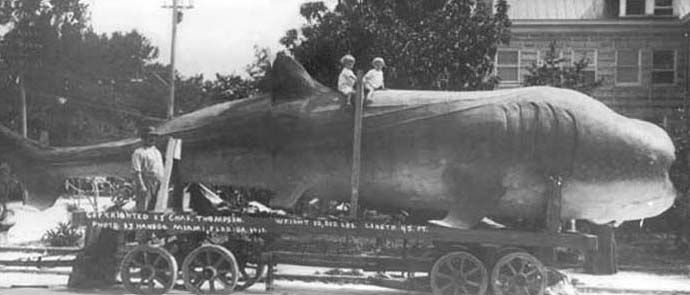
stuffed whale shark

i accidently came across this sad and rather weird story:

the largest flordia keys fish story took place in 1912 just off of knight's key. captain charles chompson of miami harpooned a 38-foot-long whale shark that reportedly took about 39 hours, five harpoons and more than 100 bullets to subdue. the 26,594-pound whale shark was towed to miami, preserved, stuffed and exhibited on a railroad flat car. the sign on the flat car read "weight 30,000 lbs. length 45 ft." all went well until it was accidentally destroyed by fire in 1922.

Friday, 27 April 2007

whale shark under boat II

this young boy of 3-4 meters was very friendly. we didn't have to find it, it found us and swam under and around the boat for 20 minutes. this gave our skipper justin his first chance to swim with a whale shark. he didn't even need to put his fins on.


to find out the sex of the whale shark i had to duck dive right next to it. usually whale sharks bank or turn their back towards you for defence if you come to close. this shark didn't bother at all, it even turned its belly towards me.

for more information about this shark click here: A-393

Tuesday, 17 April 2007

whale shark A-391

one of my first whale sharks this year - a 4m female. for more information about this shark click here: A-391


Wednesday, 4 April 2007

whale shark under boat

today i swam with my first whale shark this year! a very special one, too. probably my best whale shark encounter in 9 years of sharking at ningaloo reef. i was out on my own boat late in the afternoon when i found an 9m shark feeding in a bait ball surrounded by reef sharks and a manta ray just off south passage. my girlfriend fränzi and me swam with it for about half an hour.


at some stage the shark found our 5m runabout more interesting than the bait ball. it swam off towards the drifting boat, circled a few times under the hull...

...and finally gave it a kiss on the side with its head out of the water. it even pushed the boat around a few meters while fränzi sat on the boat.

it was fränzi's first ever whale shark - can you be more lucky?!

Sunday, 1 April 2007

whale sharks of ningaloo

for the next few months i'll be filming whale sharks every day (hopefully...).

ningaloo reef is privileged to be one of the few places in the world known to be visited by the mysterious whale shark (rhincodon typus) on a regular basis. each year, just days after the mass spawning of corals on the ningaloo reef in march and april, whale sharks appear in the waters along the front of the reef, remaining for up to a month. it is thought that they come to feed on an explosion of marine life that feeds on the coral spawn. most of these visiting whale sharks are immature males. it remains an intriguing puzzle why this particular section of the population visits our coast.


whale sharks will grow to over 12 metres in length, which is about the size of a large bus. whale sharks are not aggressive, they cruise the oceans feeding on concentrations of zooplankton, small fish and squid. whale sharks occur world-wide in tropical and temperate seas and are thought to be highly migratory. however, there is little information currently available on this aspect of their behaviour. also, the population is unknown and the species is considered vulnerable. for better understanding (and better protection) of the whale shark it is important to collect as much data as possible. a few years ago a non-profit organisation called ecocean introduced a worldwide photo identification library. in the next few weeks, i'll report all my whale shark encounters to ecocean and you'll also find some of them here in my blog.